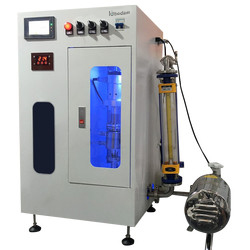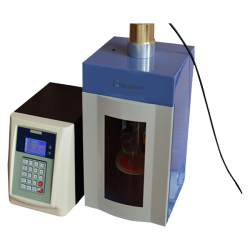



Lab-Equipment > Ultrasonic-Homogenizer > Ultrasonic-Homogenizer-Sonicator > Ultrasonic Homogenizer (Non-contact) LD-LUHS-B10
Features
- Cup Tip style offers non-contact homogenization of micro scale samples
- Excludes dregs circumstances of traditional probe
- Samples are processed in sealed cup tubes eliminating aerosols and enhances biological safety (such as Mycobacterium)
- Simultaneous processing of multiple vials of sterile or pathogenic samples
- Programmed uninterrupted rotation of the centrifuge tube facilitates uniform distribution of ultrasonic energy
- Imperative standard device for ChIP (chromatin immune precipitation) and DNA shear research platforms
- Higher efficacy, steadfast results and good repeatability
- Standardized experimental method and advanced parameter settings
- Optional coolant circulation system to maintain temperature at 4 °C in Eppendorf tube rotating base
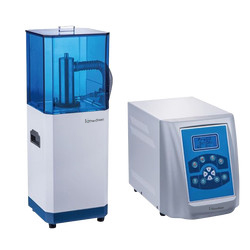
Ultrasonic Homogenizer (Non-contact) LD-LUHS-B10
Ultrasonic Homogenizer (Non-contact)LD-LUHS-B10is a cup-form homogenizer with 700 ml disruption capacity. With 19.5 to 20.5 KHz operation frequency, it is used for disruption of cells, for emulsification, homogenization of varied biological samples with minimum up to 5 μL volume. It can be used for breaking up chromosome and crushing cells aseptically across centrifugal glass tube.
SKU Code: LD-LUHS-B10
Also Available in below capacities
Operating frequency : 19.5 to 20.5 KHz
Operating frequency : 28 ± 1 KHz
Operating frequency : 20 ± 1 KHz
- Specifications
- Product Applications
| Horn | 20 mm |
| Display | LCD Display |
| Duty ratio | 0.1 to 99.9 % |
| Gross weight | 19.4 kg |
| Power supply | 220 /110 V ± 0.5, 50 Hz / 60 Hz |
| Packing Dimension | 560 × 440 × 480 |
| Power consumption | 1200 W |
| Processing volume | (0.1 to 2ml) × 4 |
| Total working time | 1 to 999 mins |
| Disruption capacity | 700 ml |
| Operating frequency | 19.5 to 20.5 KHz |
| Temperature Display | Yes ( prevent sample overheating ) |
| Used in bimolecular fragmentation, cell disruption, ChIP assay (Chromatin immune precipitation), next generation sequencing DNA, elute membrane proteins, homogeneous emulsification reactions and pre-treatment of ultrasonic exquisite samples. |