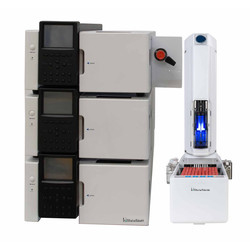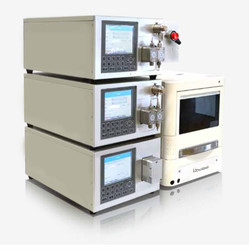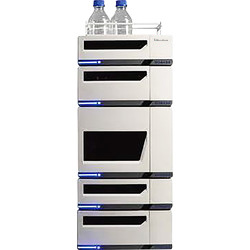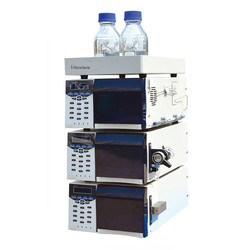



Analytical-Instruments > HPLC > Semi-Prep-HPLC > HPLC system LD-LHLC-A10
Features
- Limit baseline noise can be ensured using electronic pulse suppression technique
- High pressure single pump
- Easy to change gasket ring & automatic washing function for the column
- User-friendly software for smooth operations
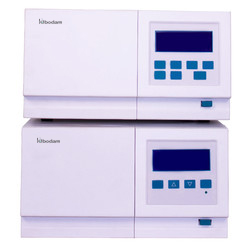
HPLC system LD-LHLC-A10
This HPLC system is equipped with high-pressure constant-current pump and UV detector. Pressure pulsation is controlled by diaphragmatic damper in seconds. The UV detectors helps in identification of samples and elutes that are colourless, odourless in nature. There is auto boot detection function available in this HPLC system.
SKU Code: LD-LHLC-A10
Also Available in below capacities
High pressure pump : Single pump
High pressure pump : Two sets of pump
High pressure pump : High pressure gradient pump
High pressure pump : High pressure constant-current infusion pump
- Specifications
- Product Applications
| Flow cell | 8 µL |
| Pulsation | ≤ 0.1 MPa (flow rate 1 ml / min, Pressure 5 - 10 MPa) |
| UV Detector | |
| Baseline drift | ≤ ± 0.4 × 10⁻⁴ AU (empty cell) |
| Baseline noise | ≤ ± 0.25 × 10⁻⁵ AU (empty cell) |
| Pressure range | ≤ 0.5 MPa (0 - 42 MPa) |
| Flow rate range | 0.001 - 9.999 mL / min (0.001 mL / min increment) |
| Mixing accuracy | ± 1 % |
| Mixing precision | ± 0.2 % |
| High pressure pump | Single pump |
| Limit of detection | 3 × 10⁻⁹ g / mL (naphthalene methyl alcohol solvent) |
| Size (W × H × D) | 450 × 300 × 160 mm |
| Flow rate precision | RSD < 0.06 % |
| Spectrum band width | 8 nm |
| Wavelength accuracy | ± 1 nm |
| Qualitative analysis | RSD 6 ≤ 0.1 % (naphthalene methyl alcohol solvent) |
| Wavelength precision | < 0.1 nm |
| Flow rate setting error | Ss ≤ 2 % (1 mL / min water, 5 - 10 MPa, room temperature) |
| Quantitative repeatability | RSD 6 ≤ 0.3 % (naphthalene methyl alcohol solvent) |
| The HPLC has applications in separation of mixture of compounds in chemical analysis, poison analysis, environmental analysis, protein food detection, medicine testing, and polymer analysis. |